Trash can

Prev Next

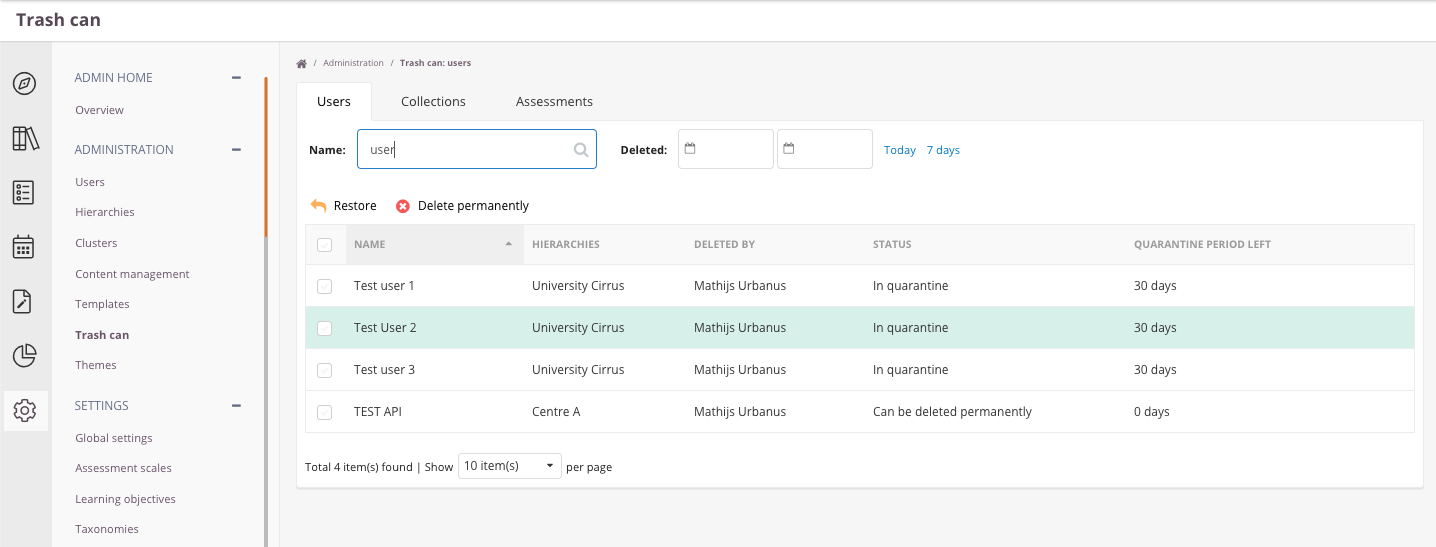
The trash can holds deleted users, collections, and assessments for 30 days. Within that window you can restore them; after it, they can be permanently deleted. Use this article to understand the quarantine rules and the restore flow.

What goes into the trash can

  • Users deleted from Admin > Users.
  • Collections deleted from the library.
  • Assessments deleted from the Assessments overview.

Deletion in Cirrus is not immediate. Every deleted item lands in the trash can for a 30-day quarantine. During that period the data is preserved and reversible.

Quarantine period

  • For the first 30 days, the deleted item can be restored.
  • After 30 days, the item can be permanently deleted from the trash can. Permanent deletion is irreversible.
  • Cirrus does not auto-purge after 30 days; the trash can keeps the item until a System Administrator empties it.
Reversible by design

The quarantine exists so accidental deletions can be recovered. Users, collections, and assessments often have downstream references (schedules, marking, reports). The trash can is the safest single place to recover from a mistake.

Permissions

Access to Admin > Trash can is typically restricted to the System Administrator role. Site administrators can grant the permission to other roles through Admin > Roles > Site.

A user with trash-can access can:

  • Restore an item: it reappears in its original location.
  • Permanently delete an item (after the 30-day window).

Restore an item

  1. Open Admin > Trash can.
  2. Find the item.
  3. Select Restore.

The item reappears:

  • A restored user shows up under Admin > Users.
  • A restored collection shows up in the library.
  • A restored assessment shows up under Assessments.

Trash can with restore options

Permanently delete an item

After 30 days, the trash can offers Delete permanently alongside Restore. Use it when you are sure the item should not come back.

Cannot be undone

Permanent deletion removes the item and any data Cirrus keeps directly with it. For users, downstream references (attempts, schedules, results) are anonymised but not deleted, to preserve the audit trail.

Related articles