
Item difficulty scale threshold
The item difficulty level is based on the P-value, one of the core concepts in psychometrics. Difficulty is important for evaluating whether an item should remain part of the assessment: items that are too easy or too hard are often removed. The P-value also helps you understand how individual items and the test as a whole function as a measurement instrument.
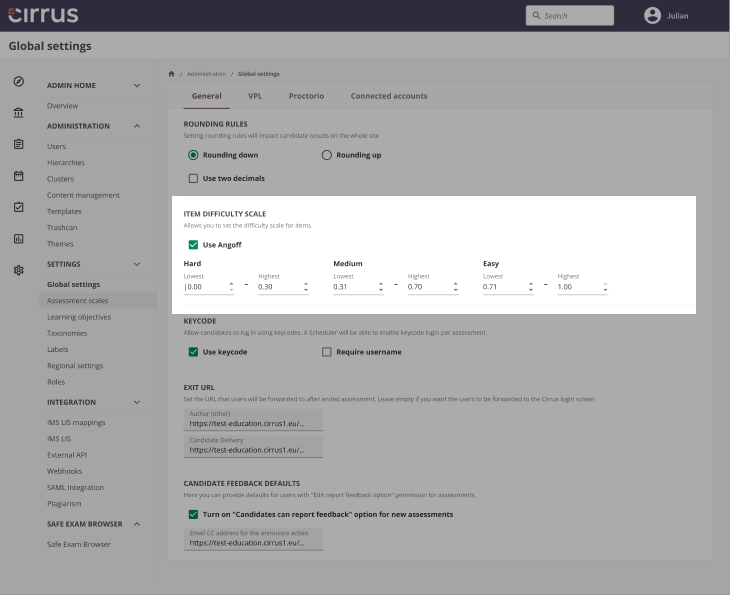
Use the item difficulty scale to set difficulty thresholds, which are then displayed automatically under Library > Collections > Statistics. This enables you to track the difficulty level of your items over time.
| Range | Interpretation | Notes |
|---|---|---|
| 0.0 - 0.3 | Hard | Candidates are at or below the chance level; the item may be too difficult or have other issues. |
| 0.3 - 0.5 | Medium (challenging) | Items in this range challenge even top candidates. |
| 0.5 - 0.7 | Medium | These items are moderately difficult. |
| 0.7 - 1.0 | Easy | These items are considered easy; the higher the P-value, the easier the item. |
These difficulty levels are reflected at the item statistics level: Library > Collection > Statistics.
The hard/medium/easy thresholds are currently displayed in item statistics only. Support for assessment performance and statistics will be added in a later release.
Use Angoff
To activate the Angoff method, see Angoff method for more information.